
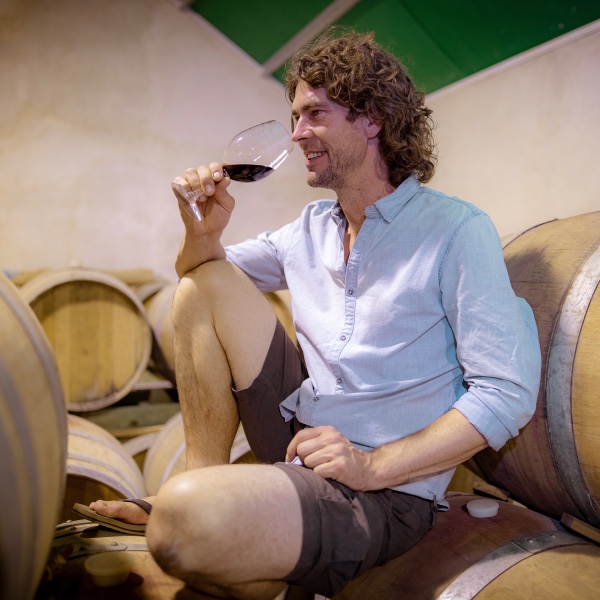
LIAM HESLOP
WINEMAKER AND MANAGER AT HESLOP WINES
“Often, wines evolve on the blending bench because they’re the best wines that came from the fruit we had that vintage.”
When did you realise you wanted to work in the wine industry?
Growing up I helped my dad in the vineyard and occasionally at the winery during vintage, so I was exposed to it for a long time. But it wasn’t until the end of high school that considered it seriously and thought it could be a good fit. I enrolled in two different courses at university, winemaking and environmental science, but I deferred it for a year so I could decide what to do. During my gap year I did a vintage in a winery and later worked in a cellar door. That was enough for me to choose winemaking!
Please tell us about your career so far, including your education, work experience, etc.
After my vintage in Mudgee I went off to study winemaking at the University of Adeliade. I then returned to Mudgee and worked at various wineries. I spent many years at Lowe Wines, starting out as assistant winemaker, before stepping up into a winemaking role. During this time, I was lucky to be able to do overseas vintages in Italy, Germany, and two in California. I also started my own brand using my father’s Zinfandel fruit. Finally, in 2017 I joined the family business Heslop Wines, and brought the brand with me, which is now called Heslop’s Mr. Rascal.
What do you love most about being in the wine industry?
The variety. Between growing, making and selling, it’s never boring. I certainly couldn’t work in an office all day!
What is your favourite wine, and what food do you typically pair it with?
It’s hard to pick a favourite when there are so many great wines to try, but I always enjoy a glass of riesling, especially German riesling. It’s very versatile and it goes with lots of different things. Cheese and charcuterie plates are always a winner, or even something as simple as pizza.
Is there a specific process you follow when developing a new wine?
It depends. Dad or I might have an idea that we’ve been wanting to try for a long time. Other times it could be that we see a gap in our portfolio, or something that we think customers might like. It could also be a combination of these things, for example that’s how we came up with both our carbonic maceration red wine and the Bush Botanicals vermouth. Often, wines evolve on the blending bench because they’re the best wines that came from the fruit we had that vintage. Sometimes during vintage, we try a small batch of something new to see if we like the results.
Is there any vintage you’re particularly proud of creating? Why?
The first vintage of my own label in 2009. It was a great year for Zinfandel and it turned out to be a lovely wine. More recently, the creation of our Bush Botanicals vermouth (same label). It’s a unique wine and has been very popular in the tasting room.
How does the local climate/soil affect the wine you make?
Mudgee has a warm, continental climate, which means we can produce many different styles and grape varieties for white, red and fortified wines.
The nice thing about that is it gives us a lot of scope for winemaking. The biggest challenge is the variability in rainfall, both the amount and timing. We have weathered shale soil with some clay and quartz, which when combined with the continental climate, gives our wines intense aromatics and plenty of structure and tannin to work with.
Which of your own varieties do you typically indulge in?
It depends on my mood and what’s available, but I always come back to the Zinfandel, Touriga Nacional, chardonnay and Bush Botanicals (vermouth made with Australian native botanicals). They’re also our most popular wines.
Where do you see yourself in five years? How do you think your winemaking will evolve during this time?
We’re still building the family business. We have a cellar door to finish, more vines to plant and ultimately want to increase production and sales overall. Our goal is always to make the highest quality wine we can, so each year we look for ways to improve, whether that be in the vineyard or in the winery. That will keep us busy for the next five years and beyond.
From Wineries of Australia 2026–2027, edited by Alice O’Brien, Belinda Coleman, Chloe Jaenicke and Stefani Grinberg