
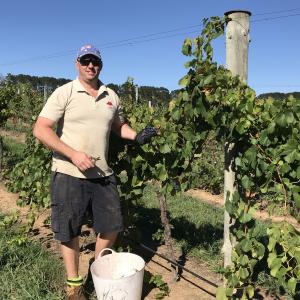
David Lorentz
DIRECTOR AND GENERAL MANAGER AT CHERRY TREE HILL
“I love the fact that we are producing a physical product that I can share.”
When did you realise you wanted to become a winemaker?
I have always had a great love for wine, instilled in me by my father, who as a boy used to travel by horse and cart through his grandmother’s vineyard in Hungary. My father purchased Cherry Tree Hill in 1980 and in 2000 I planted fifteen hectares of vines, and the rest is history!
Please tell us about your career so far, including your education, work experience, etc.
I was born and raised in Sydney and graduated Sydney Grammar School in 1990. I was in the inaugural year of the Blue Mountains International Hotel Management School and graduated with a double diploma in 1993. I stayed in hospitality for several years working in jobs ranging from bus boy at the Taste of India restaurant to function manager at the Sheraton Wentworth Hotel. During this time, I developed a great appreciation for food and wine and decided to follow the latter passion. I was fortunate enough to have a family property in one of the top emerging cool-climate regions in NSW and Australia and in 1999 I set my mind on the daunting task of building a vineyard and wine brand. As I am a sucker for punishment, in 2021 I planted another eleven hectares of vines, increasing our block to twenty-five hectares, almost half of which is Pinot Noir
What do you love most about being a winemaker?
Even though I am technically not a winemaker (my wines are made by some very good friends of mine at Artemis wines, Tom Evans and Mark and Anton Balog), I spend half of my life with them making decisions about all my wines. I love the fact that we are producing a physical product that I can share with my customers, friends and family and I get great satisfaction seeing their appreciation for these wines
What is your favourite wine, and what food do you typically pair it with?
I love French Chardonnays and would have to say my favourite is Corton-Charlemagne. This wine is so powerfully structured and remarkably complex yet has great minerality that leaves you wanting more. If I had my choice of food pairing, I would probably go decadent and choose salt and pepper lobster or scallops but these options aren’t always around so a piece of Heidi Tilset cheese would go nicely.
Is there a specific process you follow when developing a new wine?
Whether it’s a new wine or one that I have been making forever, we always follow the same basic process, although making a Riesling is very different from making a Cabernet. The main focus is taste. Wine is a product like anything else and people put it in their mouth and decide if they like it. I always do several bench trials with my winemaking team and take on all the feedback before making my final decisions. I feel it is crucial to walk away from a bench trial and revisit the wines again with a fresh mind and palate a few days later. All the decisions I make are based on what I would like to drink as I want to make a product that I love. This may not always be commercially sound, as consumers may have very different palates to me, but I’m twenty-five years in now and it seems to be working!
Is there any vintage you’re particularly proud of creating? Why?
Every vintage ending in a six has been outstanding at Cherry Tree Hill. Our 2006 and 2016 Rieslings were both judged Gold at the New South Wales Wine Awards and both won The Best Riesling in New South Wales. In 2016 we also won Best Altitude Chardonnay in Australia and Huo Hooke rated our ‘Dave’ Special Vintage Cabernet Merlot 95/100 which is an amazing feat for a cool climate Cabernet blend. Watch this space for our 2026 vintage!
How does the local climate/soil affect the wine you make?
The Southern Highlands cool climate presents many obstacles. We have endured frosts, hail, incessant rain and even bushfires, but grapes sometimes like to struggle, and we have learned over the years to manage our vineyard in a way that produces consistent award-winning wines. The great thing about growing Chardonnay, Pinot Noir and Pinot Meunier is that if we have a season when grapes are struggling to get ripe, we can pick early and make sparkling. Our ‘Gabriel’ Vintage Méthode Traditionelle medalled in the Sydney Royal Wine Show and beats a lot of French Champagnes hands down.
Which of your own varieties do you typically indulge in?
I will drink pretty much any variety, even the ones I don’t generally love, because you never know when a special wine may be in front of you unless you embrace it with an open mind. In saying this, I am generally a Burgundy man, so my go-to varieties are Chardonnay and Pinot Noir
Where do you see yourself in five years? How do you think your winemaking will evolve during this time?
Every year I try new techniques, striving to make the best wine possible, although I hope that I have reached the pointy end of perfection by now. My end goal is to make the best Pinot Noir in Australia. I believe the fruit coming off my block has the potential to achieve this. Unfortunately, since winning the National Cool Climate Wine Awards for our 2019 ‘Hayden’ Reserve Pinot Noir, we have had five difficult years with the weather but I’m looking forward to bottling our 2025 vintage and harvesting in 2026.
From Wineries of Australia 2026–2027, edited by Alice O’Brien, Belinda Coleman, Chloe Jaenicke and Stefani Grinberg