
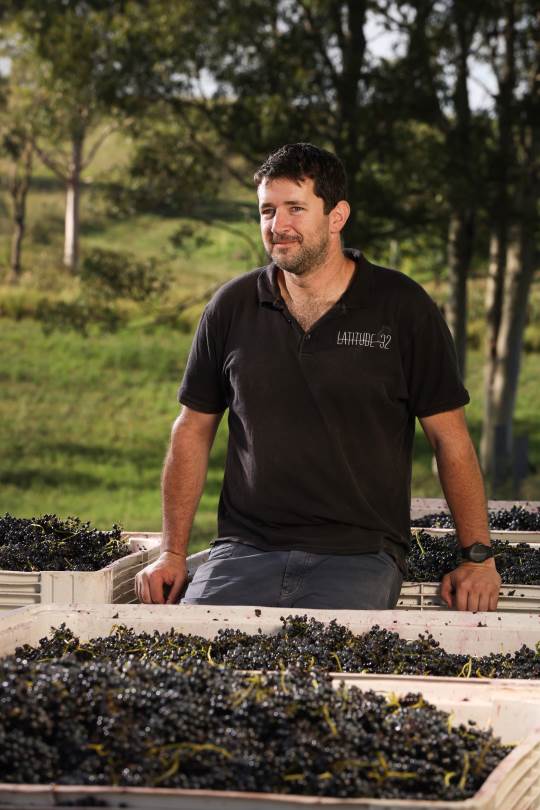
Adam Holmberg
CHIEF WINEMAKER AT LATITUDE 32
“I discovered a world of flavour and complexity that was going to be different with every year and I never looked back.”
When did you realise you wanted to become a winemaker?
It wasn’t something I had considered growing up, but I took a chance on a vintage job at one the local wineries after I finished my schooling. I discovered a world of flavour and complexity that was going to be different with every year and I never looked back.
Please tell us about your career so far, including your education, work experience, etc.
In the Murray Darling region in Swan Hill in 1999, Buller’s Wines gave me the start into my wine career where I spent six years learning the fundamentals of what is involved. I moved to the Hunter Valley in 2006 for a vintage position at Rothbury Estate. The move to the Hunter was supposed to be the start of a working holiday around Australia, but it’s now coming up to twenty years later and it’s safe to say that I’m hooked on this fantastic place to grow and make wine. I’ve had the privilege of working and learning under some of Australia’s best winemakers, with stints at Arrowfield, then at Bimbadgen with Sarah Crow, three years at Tyrrell’s with Andrew Spinaze and Mark Richardson, and ten years at Leogate with Mark Woods. In 2025 I was lucky enough to be handed the reins here at Latitude 32 where I can now put my own stamp on what I have learned over the years. I have been lucky enough to be able to complete overseas vintages in both California and Marlborough as well. I completed the Winemaking and Viticulture Diploma though Kurri TAFE before jumping into the Wine Science degree at Charles Sturt in Wagga in 2012.
What do you love most about being a winemaker?
It’s definitely not a boring job, every day and every year always brings new and exciting challenges. It’s always a great pleasure to craft what mother nature gives us every year and see the literal fruits of the vineyard turn into something truly unique while remaining within the brand’s style.
What is your favourite wine, and what food do you typically pair it with?
For me, it’s hard to go past an Aussie riesling. That clean fresh citrus with that beautiful core of acidity paired with a bucket of fresh prawns sitting somewhere along the stunning coastline is just a match made in heaven.
Is there a specific process you follow when developing a new wine?
We have a philosophy of creating wines for the consumer here at Latitude 32, so we are always listening to our members and customers while keeping our eyes on what’s trending in the market and looking for what’s exciting in the emerging varieties.
Is there any vintage you’re particularly proud of creating? Why?
I’m always proud of what we create every year, but I would say that the 2025 vintage with the first proper harvest of the old Mistletoe blocks and my first time having complete control will always have a special place in my heart. We’ve created some exceptional wines from this year and can’t wait to see them out in the market.
How does the local climate/soil affect the wine you make?
The climate is the best and the worst thing about growing grapes in the Hunter. It’s what allows us to create our beautiful semillons and wonderful medium bodied shirazes, while at the same time a poorly timed summer thunderstorm can turn all your hard work in the growing season into a pile of shredded leaves and smashed berries. Across our vineyards we have a majority of red ‘Pokolbin’ clay – hard as a rock when its dry and sticks to your boots when it wet. It has its challenges in wet years yet always provides us with fantastic fruit to work with.
Which of your own varieties do you typically indulge in?
It always hard to go past a well-made Hunter semillon, whether still young and fresh or developing into its unctuous aged beauty. As far as our reds go, I’m developing a big soft spot for the shiraz pinot blends, just a great mix of beautiful fruits and spice.
Where do you see yourself in five years? How do you think your winemaking will evolve during this time?
Still here, always learning about how our vineyards and varieties perform in different conditions. Always listening to the consumers to keep our styles fresh and relevant to what the people want to drink, while building on the traditions that we have started.
From Wineries of New South Wales – Issue 2