
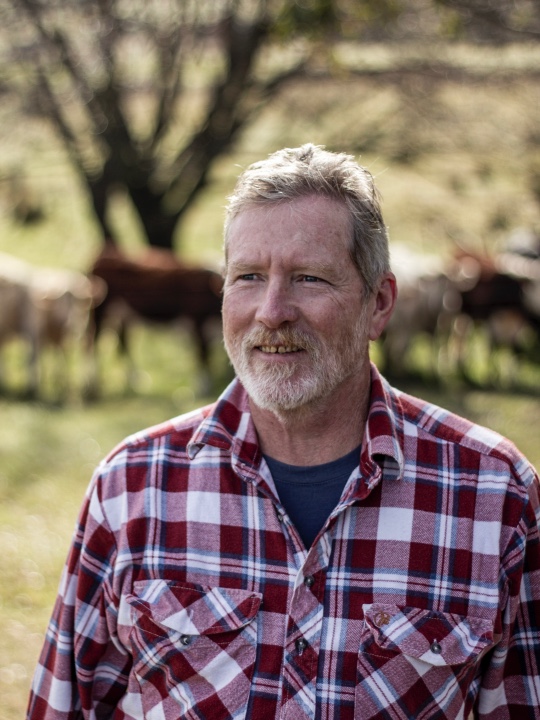
Richard Cottam
JOINT OWNER AND VITICULTURIST AT MOUNT TUMBARUMBA VINEYARD
“There’s a rhythm to it that’s hard to explain unless you’ve lived it. You work with the seasons, not against them.”
When did you realise you wanted to become a viticulturalist?
I’ve always been drawn to the natural world, plant biology, geography, landscapes. I like to observe the way a place holds itself. My wife, Elvie Yates, had a strong curiosity about wine and that led us to spend a lot of time visiting vineyards. We’d ask questions and taste everything. I’m a fifth-generation local of Tumbarumba. About forty years ago, we started thinking about establishing a vineyard on family land that had been with us for nearly a century. Once I began studying viticulture at Charles Sturt University, that interest deepened. I still believe that great wine is largely made in the vineyard. The winemaker can guide it, but the foundations are already there in the fruit.
Please tell us about your career so far, including your education, work experience, etc.
I’ve been involved in the wine industry for more than thirty-five years, though the first two decades ran in parallel with a career in public service, mostly in project management.
During that time, I studied viticulture at Charles Sturt University, taught vineyard establishment through the TAFE system, advised on vineyard development across the Canberra district, and managed a vineyard there for close to ten years.
At the same time, my wife and I were establishing our own vineyard in Tumbarumba, so it was always a balancing act between theory, teaching, and getting our own hands dirty.
What do you love most about being a viticulturalist?
There’s a rhythm to it that’s hard to explain unless you’ve lived it. You work with the seasons, not against them.
I like the solitude, being out in the vineyard early, when it’s just you and the landscape. But equally, I value the connections: working with winemakers, vineyard crews, and people across the industry, as well as those who come and experience our wines.
But if I had to choose one moment, it’s when someone tastes the wine, looks up, and simply says, “Wow!” That sense of connection never diminishes.
What is your favourite wine, and what food do you typically pair it with?
A Tumbarumba chardonnay is hard to go past.
I like to pair it with a good quality chicken, coated in Dijon mustard, cooked slowly, then finished with crème fraîche poured over in the last twenty minutes. Just before serving, I’ll add a knob of butter to the jus, the French way.
With the right chardonnay, ideally cold climate, it’s one of those meals where everything just comes together, rich, balanced, and quietly indulgent.
Is there a specific process you follow when developing a new wine?
My wife would say it usually starts with a robust discussion.
I tend to be more conservative, while she’s always looking for the next opportunity or idea to explore. Somewhere between the two is where the decisions get made.
Vintage conditions and stock levels play a big role in shaping what we produce each year. We also work closely with our winemaker, Alex McKay of Collector Wines, testing ideas and refining them until we land on something that feels right.
It’s never a fixed formula. It evolves each season.
Is there any vintage you’re particularly proud of creating? Why?
It’s difficult to single one out. Each vintage tells its own story, and you become attached to all of them in different ways.
Some seasons test you; frost, slow ripening, logistical challenges around pruning and picking. But those are often the years where you learn the most.
Over time, you start to appreciate the nuances each season brings, the subtle differences in structure, flavour, and balance. Just as you come to fully understand one vintage, the next begins, and the process starts again.
That’s part of the appeal. It never stands still.
How does the local climate/soil affect the wine you make?
Tumbarumba sits firmly in the cool (some would say cold) climate spectrum. That long, slow ripening period is everything. It builds flavour gradually and preserves natural acidity, which gives the wines their freshness and precision.
Our soils are predominantly granite and importantly, the vineyard is dry grown. The vines have never been irrigated, so they’ve had to push deep into the ground to find what they need.
That struggle tends to show in the glass. It gives the wines structure, intensity, and a real sense of place.
Which of your own varieties do you typically indulge in?
Probably our rosé. It’s approachable, versatile, and doesn’t demand too much of the moment. It works just as well on its own as it does with food, especially dishes with a bit of spice.
With the right food, I can’t go past the chardonnay.
Where do you see yourself in five years? How do you think your winemaking will evolve during this time?
Still in the vineyard.
I’d like to remain actively involved, but more importantly, I’d like to see the next generation stepping in, with family members who are keen to be a part of it.
There’s something satisfying about passing knowledge on and seeing others shape the next phase of the vineyard.
From Wineries of Australia 2026–2027, edited by Alice O’Brien, Belinda Coleman, Chloe Jaenicke and Stefani Grinberg